For the past decade, the longevity conversation in travel and customer experience ran on two assumptions:
The first: longevity is a clinical pursuit, delivered by specialty providers —
The second: the operators best positioned to deliver it are the ones already in the wellness business.
Both assumptions are now wrong, because the longevity stack just walked into three categories that were not in the longevity conversation eighteen months ago.
A quick definition, because the word gets stretched. Longevity is not anti-aging marketing or a spa afternoon. It is the pursuit of healthspan, the years you live in good function rather than simply the years you live. In a wellbeing context that means proactive, measurable support for the inputs that decide how well the body holds up: sleep, recovery, metabolic health, and cognition. The longevity stack is the set of tools that deliver it, from biomarker testing to recovery sleep. Wellness used to sell relaxation. Longevity sells outcomes.
The airport: Wait n’ Rest at Miami International. According to International Airport Review, Miami International Airport opened the first Wait n’ Rest sleep rooms in North America. Fifteen private rooms accommodate one to four passengers each, with hotel-grade bedding, private showers, and hourly pricing starting at $40. Sleep is the most under-priced longevity intervention in travel, and the most disrupted by transit itself. Miami just made recovery sleep terminal infrastructure, available to anyone with a credit card and a layover.
The residence: Six Senses London at The Whiteley. Six Senses is a wellness brand. That is precisely what makes this example land differently. When Six Senses opens a property, nobody is surprised by the magnesium pool, the longevity clinic, or the biomarker analysis. What is surprising is where this one opened: inside The Whiteley, a mixed-use redevelopment in Bayswater with 14 branded residences, in a market where residential developments have historically competed on square footage, finishes, and postcode. Six Senses did not open a wellness resort. They moved the longevity stack (biomarker analysis, PEMF therapy, sleep tracking, cryotherapy, longevity clinic) into a category that did not think it needed them. The residents did not buy into a wellness retreat. They bought into a London address that now comes with what was a destination-clinic stack five years ago.
The cruise: Crystal’s longevity-at-sea retreat. According to Crystal Cruises’ announcement of its third annual Wellness at Sea retreat voyages, the program aboard Crystal Symphony sails in August 2026 with an explicit focus on longevity science, aging well, cognitive performance, and emotional health, alongside yoga, sound baths, functional training, and a two-day detox at sea. A new October retreat aboard Crystal Serenity adds Sanctum, the music-led movement practice from Amsterdam. Crystal’s Wellness Ambassador, Dalila Roglieri, framed the move plainly: “At Crystal, wellness is not an amenity, it is a philosophy woven into the guest journey.”
The numbers behind the shift are sized accordingly. According to the Global Wellness Institute’s May 2026 wellness real estate data preview, the global wellness real estate market reached $876 billion in 2025 and is forecast to double to $1.8 trillion by 2030, growing at roughly 23.5 percent annually since 2019. According to the 2026 Research and Markets wellness tourism report, global wellness tourism grew from $974.57 billion in 2025 to $1.06 trillion in 2026, a 9.6 percent year-over-year increase. The three examples above are early signals of a sector that has been growing quietly for the better part of a decade, with longevity now the fastest-moving sub-category inside it.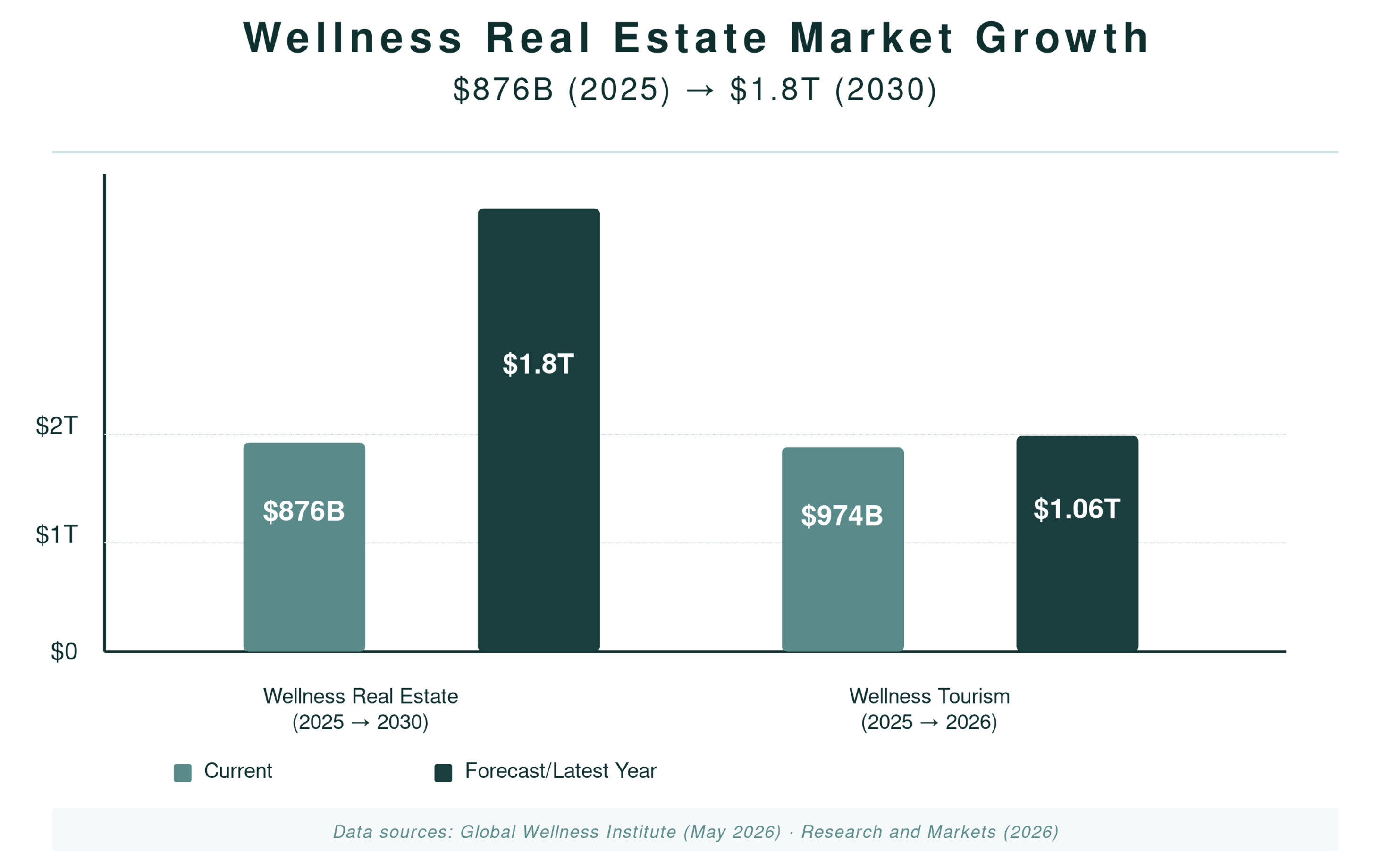
Wellness resorts and dedicated longevity clinics have priced their premium against one assumption: that baseline properties would not deliver the same programming. The baseline now does. Properties that embed wellness into the operating model are now capturing that premium. According to the sixth edition of the HotStats and RLA Global Wellness Real Estate Report, the leaner “minor wellness” properties, the ones running activations rather than full clinical operations, posted the strongest year-over-year RevPAR and TRevPAR growth across the luxury and upper-upscale segments in 2024. The pricing logic of the legacy wellness segment has run out of runway.
An airport in Miami, a city hotel in Bayswater, and a luxury cruise line all moved longevity into the base layer of their respective operating models inside the same eighteen-month window. None are spa-segment. None were in the longevity conversation two years ago. All three now compete on dimensions that the destination wellness segment used to own outright.
Final Thought
Longevity is the wellness vertical that operators are racing to install as infrastructure. The brands that absorb this now will redesign their experience model around the new floor inside twelve months, while everyone else waits and reprices on someone else's calendar.
Two questions worth sitting with before your next experience-model review.
Where does longevity currently sit in your experience model: as a clinical add-on, a paid upgrade, or part of the base layer? If the answer is add-on or upgrade, you are pricing against a baseline that has already moved.
What share of your new bookings comes from customers who can name a specific longevity or wellness feature of your product before they arrive? If that number sits below 20%, the layer is invisible at the point of purchase, which means it is functioning as an amenity regardless of how much you've invested in it.
If you want a read on where longevity sits in your experience model and what it would take to move it into the base layer, let’s talk.